Volleyball is a fast-paced and exciting sport—but to truly understand the game, you need to know the different volleyball positions and what each player does.
Whether you’re a beginner, a parent, or an aspiring athlete, this guide will break everything down in a simple, practical, and easy-to-understand way—plus give you insights your competitors missed.
What Are Volleyball Positions?
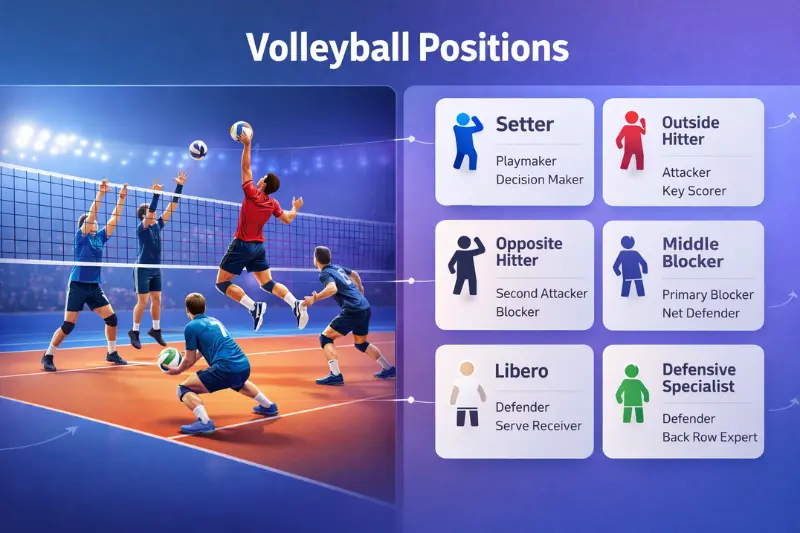
In volleyball, there are six main positions on the court, and each one has a unique role in offense and defense.
These positions work together like a system—if one fails, the whole team struggles.
The 6 Main Volleyball Positions:
- Setter
- Outside Hitter (Left Side)
- Opposite Hitter (Right Side)
- Middle Blocker
- Libero
- Defensive Specialist
Volleyball Court Positions Explained (With Roles)
Setter (The Playmaker)
The setter is the brain of the team.
Main Responsibilities:
- Set the ball for attackers
- Decide who gets the ball
- Control the team’s offense
Skills Needed:
- Quick decision-making
- Strong communication
- Soft and accurate hands
Think of the setter like a quarterback in football—they run the offense.
Outside Hitter (Left Side)
The outside hitter is the team’s main attacker.
What They Do:
- Spike the ball most often
- Receive serves
- Play both front and back row
Why It’s Important:
- They handle difficult sets
- Often score the most points
Best For:
Players who are athletic, consistent, and adaptable
Opposite Hitter (Right Side)
The opposite hitter balances offense and defense.
Key Roles:
- Attack from the right side
- Block the opponent’s outside hitter
- Support defense
Unique Advantage:
- Often faces the opponent’s strongest attacker
This is one of the most strategic positions on the court.
Middle Blocker (The Wall)
The middle blocker is the team’s first line of defense.
Responsibilities:
- Block opposing hitters
- Perform quick attacks near the net
Important Traits:
- Height
- Speed
- Timing
They must read the game quickly and move fast along the net.
Libero (Defensive Leader)
The libero is easy to spot—they wear a different jersey.
Main Job:
- Receive serves
- Dig (defend) attacks
- Control the back row
Rules:
- Cannot attack the ball above the net
- Cannot block
- Plays only in the back row
The libero is the defensive backbone of the team.
Defensive Specialist (DS)

The defensive specialist focuses on defense and passing.
What They Do:
- Substitute for weaker defenders
- Improve ball control
- Help in serve receive
Difference from Libero:
- Can rotate normally
- Counts as a substitution
Bonus Role
Serving Specialist
A serving specialist is subbed in only to serve.
Why Teams Use Them:
- To score points with strong serves
- To apply pressure on opponents
How Rotations Work in Volleyball
Many beginners get confused here, so here is a simple explanation:
- Players rotate clockwise after winning a serve
- Each player must play both front and back row (except libero)
- Positions change, but roles stay the same
For example, a setter may start in the back row but still sets the ball.
Which Volleyball Position Is Right for You?
Choosing the right position depends on your skills and physical abilities:
| If You Are… | Best Position |
|---|---|
| Tall and fast | Middle Blocker |
| Great decision-maker | Setter |
| Strong and consistent hitter | Outside Hitter |
| Balanced offense and defense | Opposite |
| Quick and defensive | Libero |
| Good passer | Defensive Specialist |
Pro tip: Try different positions early to find your best fit.
Common Mistakes Beginners Make
Avoid these mistakes to improve faster:
- Only focusing on hitting instead of passing
- Ignoring positioning and rotations
- Poor communication with teammates
- Not learning multiple skills
Volleyball is a team sport, and versatility is key.
Pro Tips to Improve in Any Position
- Practice serve receive regularly
- Improve footwork and movement
- Communicate constantly
- Watch professional matches to understand positioning
Frequently Asked Questions (FAQs)
What is the hardest position in volleyball?
The setter is often considered the hardest because they control every play.
Which position scores the most points?
The outside hitter usually scores the most.
Can a libero be a captain?
Yes, in many leagues, the libero can be the team captain.
Do players stay in one position?
No, players rotate, but their roles remain the same.
Final Thoughts
Understanding volleyball positions is the first step to becoming a better player.
Each role matters, and when every player performs their job well, the team becomes stronger and more effective.
Whether you’re playing for fun or competition, mastering your position will give you a big advantage on the court.